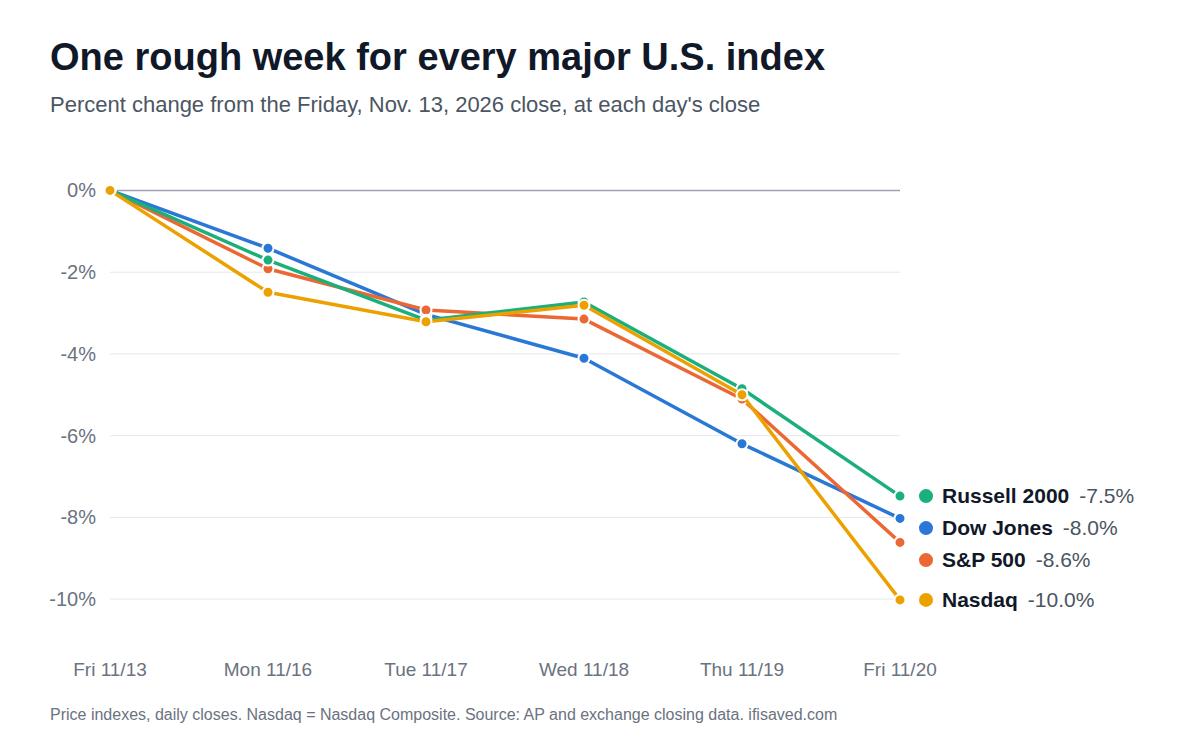
If you opened your 401(k) or brokerage app this week, you probably did not like what you saw. From the close on Friday, November 13 to the close on Friday, November 20, 2026, every major U.S. stock index fell hard:
- Nasdaq Composite: down about 10.0%, its worst week since March 2020, wiping out its gains for the year
- S&P 500: down about 8.6%, with seven losing days in a row
- Dow Jones Industrial Average: down about 8.0%, more than 4,200 points
- Russell 2000 (smaller companies): down about 7.5%
The S&P 500 and the Dow both finished the week in correction territory, more than 10% below their recent highs, after a sharp sell-off in AI and technology stocks spread to almost everything else. Here is how the week played out, day by day:
A week like this makes a lot of people want to do something: sell, move everything to cash, stop contributing until things calm down. This post is about why the market should not be the one making that decision for you, and what history says about weeks like this one.
1. Dips Are Where Great Fortunes Get Built
The investors with the biggest fortunes are famous for doing the opposite of what most people feel like doing in a crash. They treat a falling market as a sale.
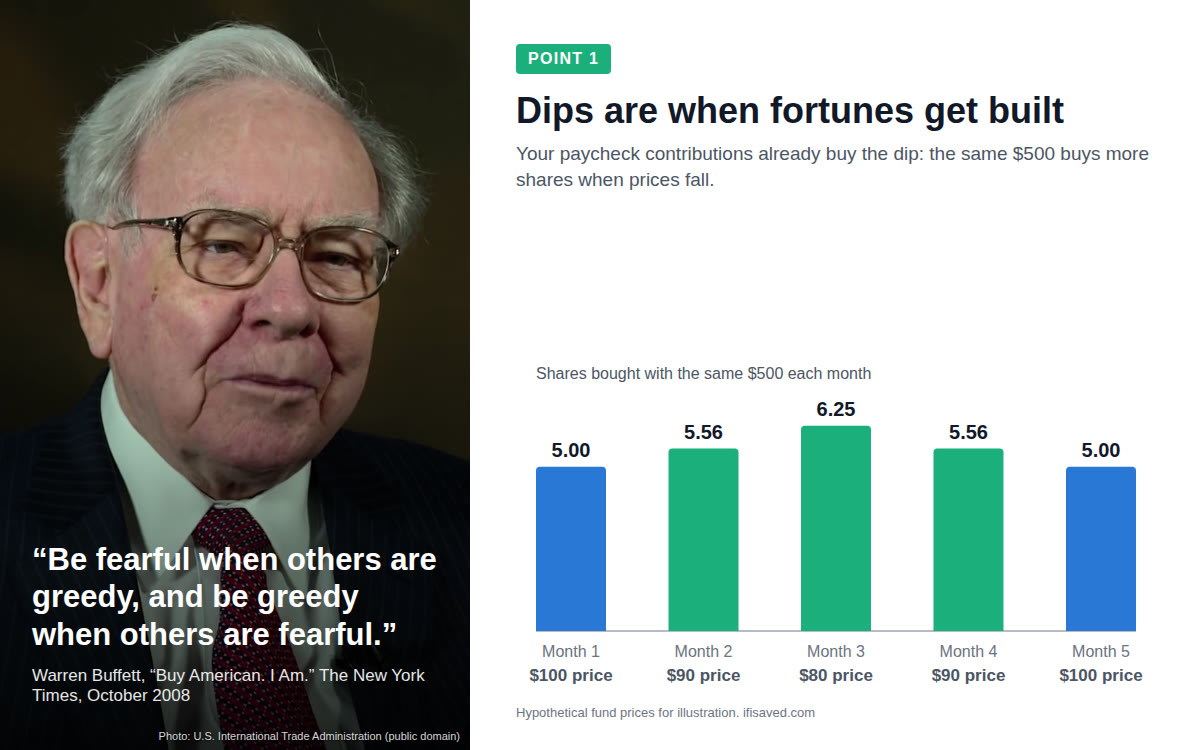
In October 2008, in the middle of the financial crisis, Warren Buffett wrote an op-ed in The New York Times titled "Buy American. I Am." He explained that he was buying U.S. stocks in his personal account, and repeated his simple rule: "Be fearful when others are greedy, and be greedy when others are fearful." A few weeks earlier, Berkshire Hathaway had put $5 billion into Goldman Sachs on terms that only a panicked market would offer, a deal widely reported to have earned Berkshire billions.
The logic is simple. The companies in the S&P 500 did not become 8.6% less valuable as businesses in five days, but their shares got 8.6% cheaper. Someone who buys this week is buying the same companies at a lower price than they were a week ago.
You do not need billions to do this. If you contribute to a 401(k), IRA, or brokerage account every paycheck, you are already buying the dip automatically. A $500 contribution buys 5 shares of a $100 fund, but 5.56 shares when that fund drops to $90. Those extra shares are what grow when prices come back. Pausing your contributions during a drop means you stop buying exactly when things are on sale.
2. You Don't Lose Money Until You Sell
When your balance falls, the drop is real, but it is not final. You own the same number of shares you owned last week, and those shares are simply priced lower today. Investors call this an unrealized loss. It only becomes a realized loss, locked in permanently, when you sell.
The 2008 crash is the clearest example. The S&P 500 peaked at 1,565 on October 9, 2007, and fell 56.8% to 677 on March 9, 2009. Here is what happened to $10,000 invested at that peak, which was close to the worst possible moment to buy:
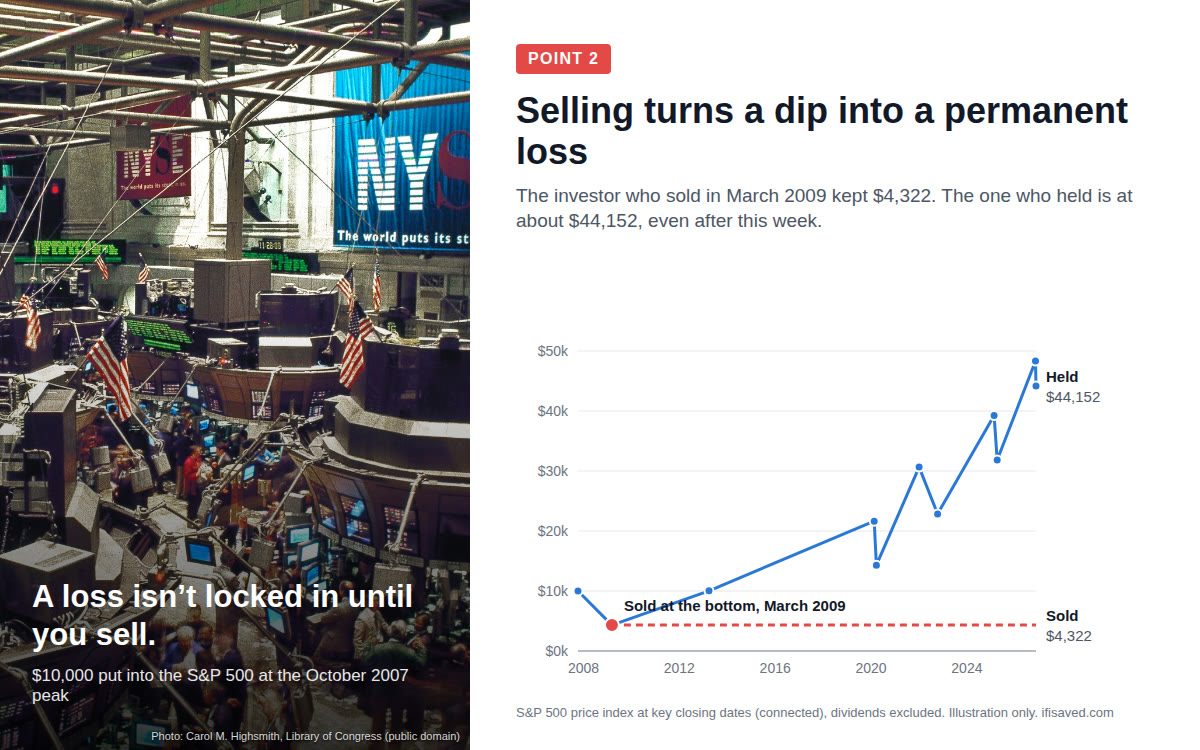
- Sold at the bottom: about $4,322. More than half the money is gone for good, and the only way back is to buy in again, usually at higher prices.
- Held until the old high: about $10,026 by March 2013. Painful years, but the loss disappeared.
- Held through this week's drop: about $44,152, more than four times the original amount, even after this week's drop.
Those numbers use the index price only. With dividends reinvested, the investor who held on would have recovered sooner and ended up with even more. The investor who sold got no dividends from stocks at all.
3. Sell Now and You'll Likely Miss the Recovery
Selling after a drop requires two perfect decisions: when to get out, and when to get back in. The second one is harder, because the market's best days tend to arrive right next to its worst ones, when the news still looks terrible.
- On October 13, 2008, in the middle of the crisis, the S&P 500 jumped 11.6% in a single day, one of its best days ever.
- On March 24, 2020, the day after the COVID bottom, it rose 9.4%.
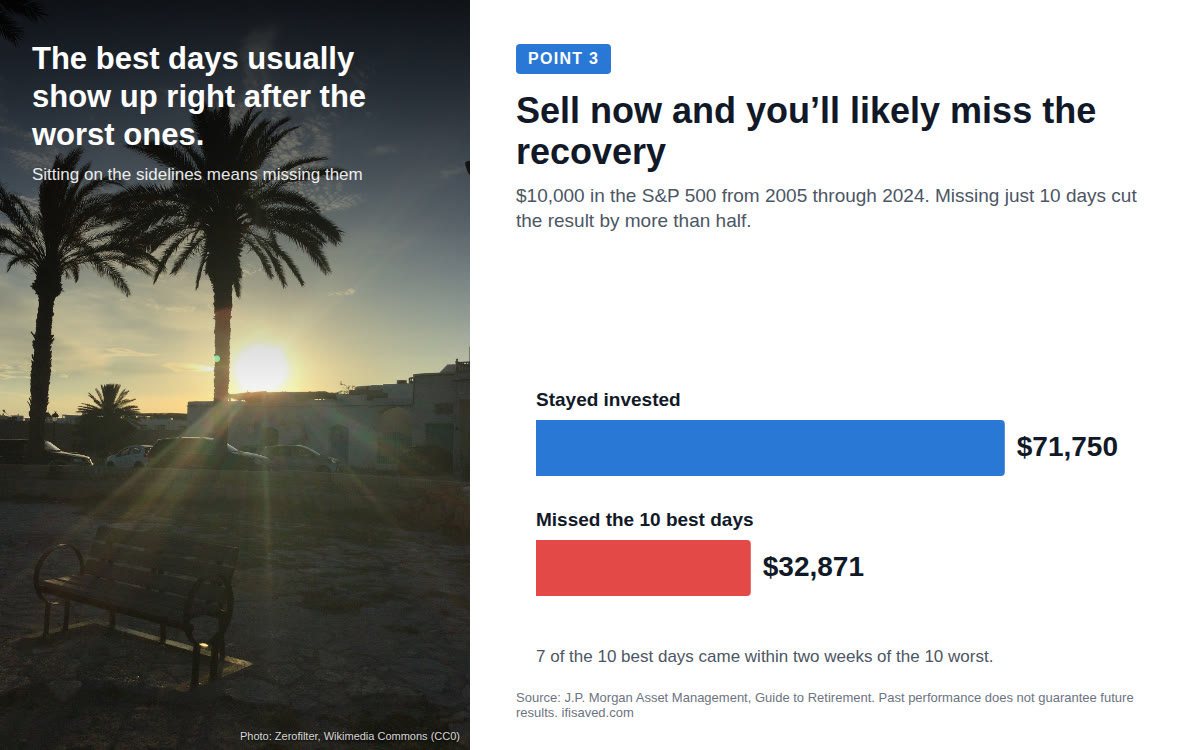
- J.P. Morgan Asset Management found that 7 of the 10 best days for the S&P 500 over the last 20 years came within two weeks of the 10 worst days.
Missing just a few of those days is expensive. In J.P. Morgan's analysis, $10,000 invested in the S&P 500 from 2005 through 2024 grew to about $71,750. An investor who missed only the 10 best days in those 20 years ended up with about $32,871, less than half.
Recoveries have also come faster than most people expect:
| Drop | S&P 500 fall | Bottom | Back to a new high |
|---|---|---|---|
| 2008 financial crisis | -56.8% | Mar 9, 2009 | Mar 28, 2013 (4 years) |
| 2020 COVID crash | -33.9% | Mar 23, 2020 | Aug 18, 2020 (5 months) |
| 2022 bear market | -25.4% | Oct 12, 2022 | Jan 19, 2024 (15 months) |
| 2025 tariff sell-off | -18.9% | Apr 8, 2025 | Jun 27, 2025 (under 3 months) |
And the bounce off the bottom is often the biggest part of the move. One year after the March 2009 low, the S&P 500 was up about 69%. One year after the March 2020 low, it was up about 75%. Whoever was sitting in cash waiting for things to "feel safe" missed most of that. Since the 2009 bottom, the index has risen more than tenfold, even counting this week. The recovery did not just erase the losses; it went far beyond them.
Drops Like This Are Normal
None of this means the market cannot fall further. It can, and nobody knows what next week brings. But big drops are part of investing, not a sign that something is broken. According to J.P. Morgan, from 1980 through 2023 the S&P 500 fell an average of 14.2% from its high at some point during the year, yet it still finished the year higher in 33 of those 44 years. Volatility is the price of the long-term returns stocks have delivered.
When Changing Your Plan Does Make Sense
Not every change is a mistake. The question is whether the change comes from your life or from the headlines. Good reasons to adjust include:
- Your timeline changed. Money you need in the next few years (a down payment, tuition, the first years of retirement) should not depend on the stock market. That money belongs in cash or other stable savings, and if a week like this one exposed money that was in the wrong place, fix that.
- Your emergency fund is too thin. Having cash set aside is what lets you leave your investments alone when something goes wrong.
- You are rebalancing on a schedule you set ahead of time, not because of what happened this week.
If the drop made you realize you took on more risk than you can sleep with, that is worth thinking about too, ideally once things calm down and with a qualified professional, rather than in the middle of a sell-off.
What to Do This Week
- Keep your contributions going.
- Check your balance less often if it is stressing you out. Your long-term plan did not change on Friday.
- Look at your plan, not the ticker. In IfISaved's Retirement Planning page, the Monte Carlo analysis already assumes years with large losses. Seeing your plan hold up across thousands of rough markets is a lot more useful than watching one rough week.
The market will have more weeks like this one. The investors who come out ahead are usually not the ones who guessed the bottom. They are the ones who stayed in their seats.
This article is for educational purposes only and is not financial, tax, or investment advice. Past performance does not guarantee future results. Index figures are price-index closes from public market data; you cannot invest directly in an index. Consider speaking with a qualified financial professional about your situation.
Photos: Warren Buffett, U.S. International Trade Administration (public domain); New York Stock Exchange trading floor, Carol M. Highsmith, Library of Congress (public domain); bench at sunset, Zerofilter via Wikimedia Commons (CC0).