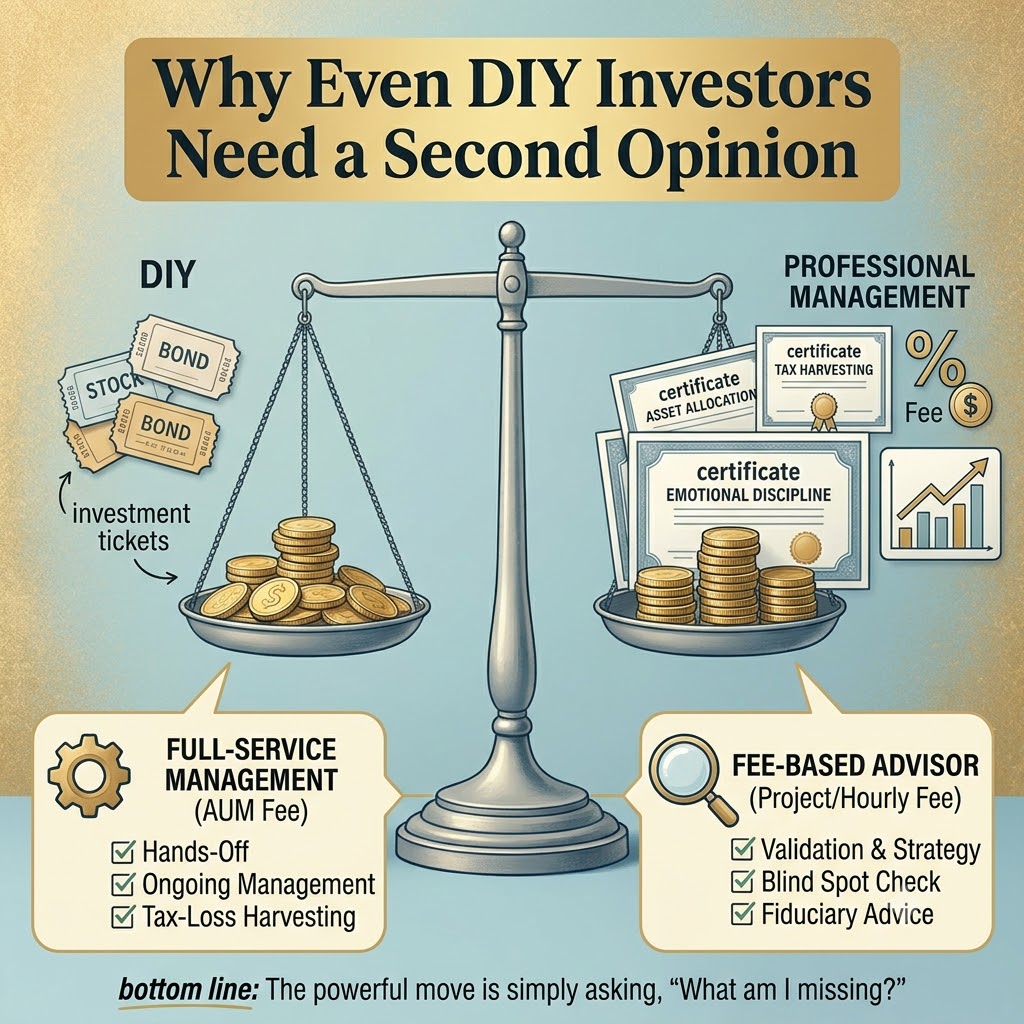
Doing your own financial planning is one of the most empowering things you can do for your future. Tracking your spending, automating your savings, choosing your own investments — it all builds real confidence and control. But there's a difference between managing your money well and managing it perfectly. And when it comes to something as important as your retirement, "well" isn't always good enough.
That's where a financial advisor comes in — not as a replacement for the work you've already done, but as a check on it.
Full-Service Management Is Worth It if You'd Rather Be Hands-Off
Managing your money requires time, research, and ongoing attention. If you have little interest in personal finance or simply prefer to spend your time elsewhere, hiring a full-service advisor who manages your portfolio for an ongoing percentage fee (AUM) is often the smartest route. They handle the heavy lifting day-in and day-out so you don't have to.
A full-service advisor will:
- Handle ongoing portfolio management and asset allocation to stay aligned with your goals.
- Execute rebalancing and tax-loss harvesting automatically to keep risk in check and save on taxes.
- Provide emotional discipline during market swings, keeping you from making panic-driven decisions.
However, if you enjoy managing your own money and just want expert validation, you don't need a full-service arrangement. Instead, you can work with a fee-based (or fee-only) advisor on a flat-rate or hourly basis to review your work.
Ways DIY investors benefit from a one time fee-based second opinion
A Second Opinion Catches What You Can't See
Even the best-laid financial plans can have blind spots. You might have built a thoughtful strategy around your 401(k), your savings rate, and your investment mix — and still be missing something. Maybe it's a tax inefficiency, an outdated beneficiary designation, or a gap in your insurance coverage. It's not that you did anything wrong. It's that when you're the one who built the plan, you're also the one least likely to spot its holes.
A second set of trained eyes exists for exactly this reason. Just like you'd want a second opinion before a major medical decision, your financial future deserves the same scrutiny.
Experience Brings a Different Point of View
A good financial advisor has seen far more scenarios than any one person could encounter on their own. They've worked with people at every stage of life, through market downturns and windfalls, career changes and family emergencies. That breadth of experience means they can bring perspective you simply don't have access to yet — while still building a plan that's personalized to your goals, your risk tolerance, and your circumstances.
The best advisors don't hand you a cookie-cutter plan. They combine what they've learned across hundreds of situations with a deep understanding of your specific life.
They Know Paths You May Never Have Been Exposed To
There's often more than one way to reach a financial goal, and some of those paths simply aren't visible from where you're standing. Whether it's a tax strategy, an estate planning tool, or a way to structure your accounts more efficiently, an experienced advisor may know of options you've never had exposure to — ones that could meaningfully change your outcome.
What to Watch Out For
Not all advice is created equal, and not every advisor is working purely in your interest. Here's what to keep an eye on:
- Watch for product pushing. If an advisor steers you toward annuities or other products that pay them a commission or royalty, ask why. That doesn't mean an annuity is never the right answer — for some people and some goals, it genuinely is. But the recommendation should be about your needs, not their compensation.
- Do your own research afterward. A good conversation with an advisor shouldn't be the end of your due diligence — it should be the start of it. If something they recommend doesn't fully make sense to you, or you don't quite agree with it, don't just go along with it. Get a second opinion.
- Look for a fiduciary. A fiduciary is legally obligated to act in your best interest, not just recommend something "suitable." This one distinction can make a significant difference in the advice you receive.
Doing things on your own is a great way to handle your finances — but complexity can add stress, and stress can cause mistakes. There's no shame in getting help when you need it. Consider using a fee-based advisor to check your work, catch what you might have missed, and confirm you're on the right track.
It might just save your retirement.