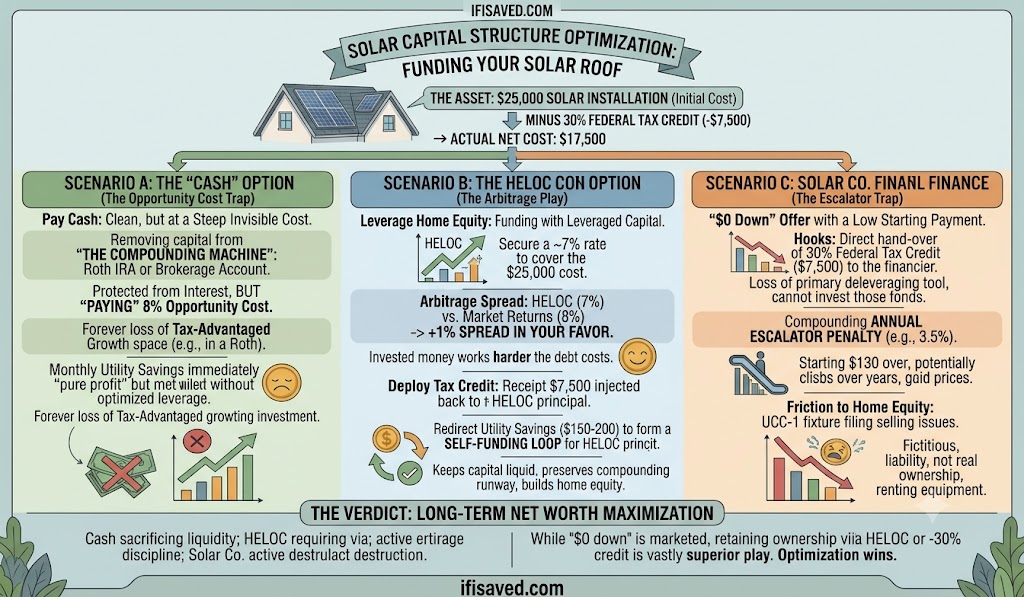
When most people look into adding solar panels to their home, they focus entirely on the environmental impact or the immediate reduction in their monthly electric bill. But if you view your household finance through the lens of long-term net worth, a $25,000 solar installation is fundamentally an investment decision.
And like any major investment, how you capital-structure the deal matters just as much as the asset itself.
If you have the means to pay cash but are also considering financing, the decision isn''t just about avoiding a monthly payment—it’s about opportunity cost and arbitrage. Let’s break down the math of funding a solar project using cash (specifically out of investment accounts) versus leveraging a Home Equity Line of Credit (HELOC).
The Baseline: The Solar Investment
Let’s assume a standard residential installation cost of $25,000.
If your localized utility bills and net metering rules clear a path to save you an average of $200 to $350 a month, you are looking at a very respectable, tax-free return on that $25,000 investment. But where does that initial $25,000 come from?
Scenario A: The "Cash" Option
Paying cash feels clean. You don't owe anyone anything, and your monthly utility savings immediately feel like pure profit. However, if that cash is currently sitting in the market—say, in a Roth IRA or a standard brokerage account—pulling it out carries a steep invisible cost.
If your retirement or brokerage portfolio is historically compounding at an average rate of 8%, taking out $25,000 means you are entirely removing that capital from the compounding machine.
- The Opportunity Cost Math: By protecting yourself from a financing interest rate, you are effectively "paying" an 8% opportunity cost on your own money.
- The Tax-Shelter Loss: If you are pulling from a tax-advantaged account like a Roth, you lose that tax-free growth space forever; you can't easily slide $25,000 back in later once the solar panels pay themselves off.
Scenario B: The HELOC Option
Now let's look at leveraging your home equity. Suppose you can secure a HELOC at a 7% variable or fixed rate to cover the $25,000 upfront cost.
On paper, paying interest sounds worse than not paying interest. But look at the spread:
- Market Growth Rate: ~8%
- HELOC Cost of Capital: ~7%
- The Spread: +1% in favor of keeping your money invested.
By financing the solar panels at 7% while leaving your $25,000 in the market earning 8%, you are successfully executing a financial arbitrage. Your invested money is working harder for you than the debt is costing you.
The Cash Flow Step-Down
To make the financing strategy truly optimal, you have to treat the incoming incentives like a business would:
- Redirect the Utility Savings: Your regular utility bill drops drastically. If you take the $200–$350 you used to pay the electric company and systematically redirect it toward the $250,00 HELOC balance, you form a self-funding loop.
Scenario C: The Solar Company Finance Option (The Escalator Trap)
Solar companies frequently offer an in-house financing option that boasts "$0 down" and a low starting monthly payment. However, the fine print contains a critical hook: the contract includes an annual payment escalator (typically between 2% and 4% per year).
On day one, the payment looks incredibly attractive because it is intentionally engineered to be slightly lower than your current utility bill. But over a 20- to 25-year term, the compounding math shifts heavily in favor of the solar provider, not your net worth.
- The Compounding Escalator Penalty: A 3.5% annual escalator sounds minor, but it compounds over time. A monthly payment that starts at a modest $130 will climb to over $220 by Year 15, and near $300 by Year 20. If retail utility inflation drops or local net metering rules change unfavorably during that time, your locked-in solar payment can easily outpace the grid price it was meant to replace.
- Friction to Home Equity: Because the solar company retains a Uniform Commercial Code (UCC-1) fixture filing or lien against the panels, selling your home becomes complicated. Prospective buyers must either qualify to assume your escalating 25-year contract, or you must pay off the remaining balance of the contract out of pocket to clear the title.
Direct Comparison: Cash vs. HELOC vs. Solar Financing
When stacked up against the first two strategies, the differences in wealth accumulation become stark:
- Ownership and Equity: With Cash or a HELOC, you own the unencumbered asset on day one. The equity value of the infrastructure stays in your home. With solar-company financing, you are essentially renting equipment on your own roof, exchanging a utility monopoly for a solar provider monopoly.
- The Arbitrage Math: While a HELOC leverages a ~7% rate against an ~8% market return to create a +1% positive spread, a solar contract with an escalator actively destroys arbitrage. Your lifetime out-of-pocket cost under an escalating loan often finishes well north of $45,000 for a $25,000 system, wiping out the financial advantage of going solar in the first place.
- Flexibility: Paying cash sacrifices liquidity, and a HELOC requires disciplined debt management. However, both allow you to control your cash flow entirely. In-house solar financing locks you into a rigid, multi-decade liability that is difficult to exit or refinance.
The Verdict
While the "$0 down" solar company finance model is highly marketed because it eliminates upfront friction, it is almost always the least efficient path for long-term net worth. If you have the credit standing to secure a HELOC or the capital to deploy Cash.
From a strict mathematical spreadsheet perspective, financing wins as long as your expected long-term market returns outpace the net cost of your debt. It keeps your capital liquid, preserves your compounding runway in tax-sheltered accounts, and lets you use the bank’s money to build equity in your home via energy infrastructure.
However, the variable in this equation is always your personal risk tolerance. If a fluctuating HELOC rate or the psychological weight of a new line of credit disrupts your sleep, the "math" changes. But if you’re looking to maximize every single dollar of your net worth over a 15-year horizon, keeping your cash compounding and financing the panels at is the textbook play.